The Five-Minute Keyword Check I Run Before I Script Anything
The decision that was already made before I opened the editor
There is a particular kind of quiet that follows a video nobody watches. Not the loud disappointment of a flop you saw coming – the quiet one, where the numbers just sit there, three days after upload, and the file on your drive represents a week you are not getting back.
For years I read that quiet as a verdict on me. Bad editor. Bad instinct. Wrong person for this job. I spent close to five years failing that way before I rebuilt everything in 2021, and the thing that finally changed was not my editing. It was the order I did things in.
Here is the uncomfortable part. By the time I opened the editor, the outcome was mostly already decided. Not by the cuts, not by the music, not by the colour grade. By a phrase I had chosen carelessly, or not chosen at all, before I wrote a single line of script.
So this article is not a theory of keywords. It is the check I run – it takes about five minutes – on a phrase before I let myself start work on a video. If you have ever finished an edit and then sat there trying to reverse-engineer a title for it, you have been doing this in the wrong order, and the fix is genuinely this small.
Why the check has to happen first
Most creators I work with treat keyword research as packaging. The video exists; now go find some words to wrap around it. That is why the words never fit. You are trying to find an audience for something you already built, instead of building something for an audience you already found.
Flip it. Pick the phrase first. The phrase tells you who is on the other side, what they are actually asking, how much they already know, and what a satisfying answer would even look like. The script writes itself much faster when you know the question.
There is a second reason, and it is the harder one to swallow: a five-minute check can kill a bad idea before it costs you a week. That is the whole value. Not finding a magic phrase – killing the ones that were never going to work while they are still free to kill.
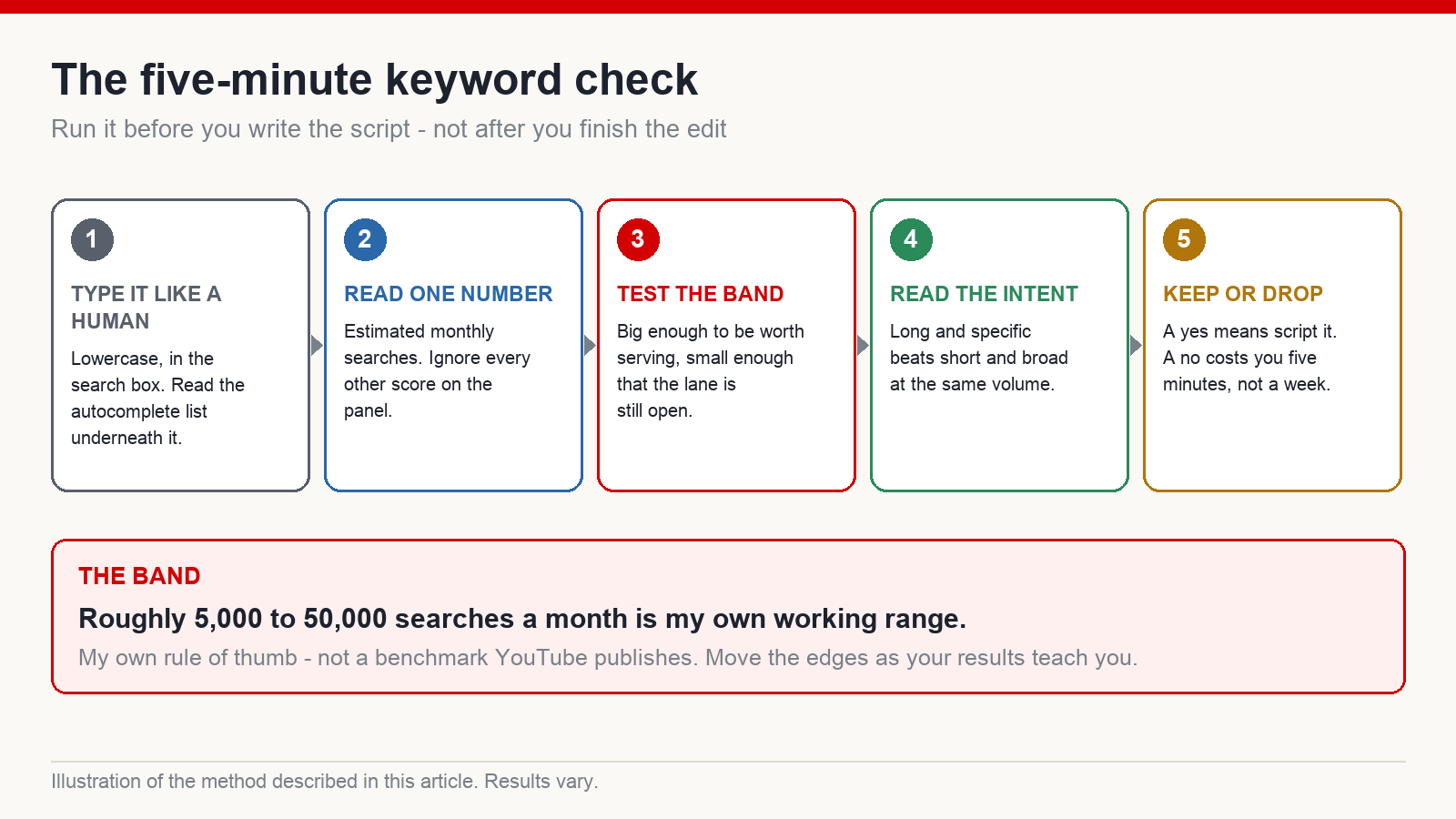
Step one: type it the way a human types it
Open YouTube. Type your phrase in the search box the way a tired person on a sofa would type it. Lowercase. No title case, no capitals, no clever punctuation.
This sounds like a triviality and it is not. Nobody searches in title case. When you write your keyword out in capitals in your notes, you slowly drift toward a phrasing that no real person uses, and then you optimise a video for a string that gets typed zero times a month. Match the human, not the style guide.
While you are there, look at what YouTube autocompletes underneath your cursor. Those suggestions are not decoration – they are a free readout of phrasings real people finish that search with. Half my best phrases have come out of that dropdown rather than any tool.
Step two: read exactly one number
You need an estimate of how many people type that phrase into YouTube in a month. There are browser extensions that overlay that estimate onto the search page; more than one exists, and I am not going to tell you which to install. Any of them that shows you a monthly search estimate does the job.
What matters is what you do once the panel opens, because they all open a wall of numbers at you. Competition score. Relevance score. Overall score. Estimated earnings. Related tags. Channel sizes. It is a cockpit, and beginners freeze in front of it.
I read one field. Monthly search volume. That is the entire measurement.
I want to be honest about why, because it is not that the other numbers are meaningless. It is that I could not act on them. When I weighed six metrics I made no decision at all – I sat there comparing, hedging, opening more tabs, and three evenings later I still had not started a video. One number that produces a yes or a no beats six numbers that produce a mood. If a rule does not end in a decision, it is not a rule, it is a hobby.
Step three: is it inside your band?
Now the test. Is that number big enough to be worth serving, and small enough that you are not walking into a street where every storefront was leased a decade ago?
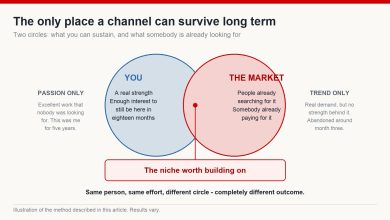
I keep a personal working band and I aim inside it: roughly five thousand to fifty thousand searches a month. I want to be very clear about what that is. It is a rule of thumb I arrived at on my own channels, not a benchmark YouTube publishes, not a number anyone has validated for your niche or your language. Treat it as my starting guess, then move the edges as your own results teach you something.
The logic behind the band is worth more than the band itself. Below the floor, even winning outright gets you an audience too thin to teach the algorithm anything about who your channel serves. Far above the ceiling, the phrase belongs to channels that have been ranking on it since before your account existed, and you are one more drop in a very full bucket.
Inside the band, I mix. A few phrases near the low end, because those are where a new channel can actually surface within weeks. Two or three near the high end, held in reserve as the direction to expand once something starts working. Low end for traction, high end for room to grow.
And the honest caveat: nothing about landing in a band guarantees views. It only means you are not spending a week competing for a phrase you had no chance at, or one nobody was ever going to type.
Step four: read the intent behind the phrase
Volume tells you how many. It tells you nothing about how badly they want it. Two people walk into the same shop. One asks what things cost, eyes already drifting to the door. The other asks for one specific item, in one specific configuration, and they have mentally paid for it before they finish the sentence.
Search phrases work the same way, and the shape of the phrase gives the person away.
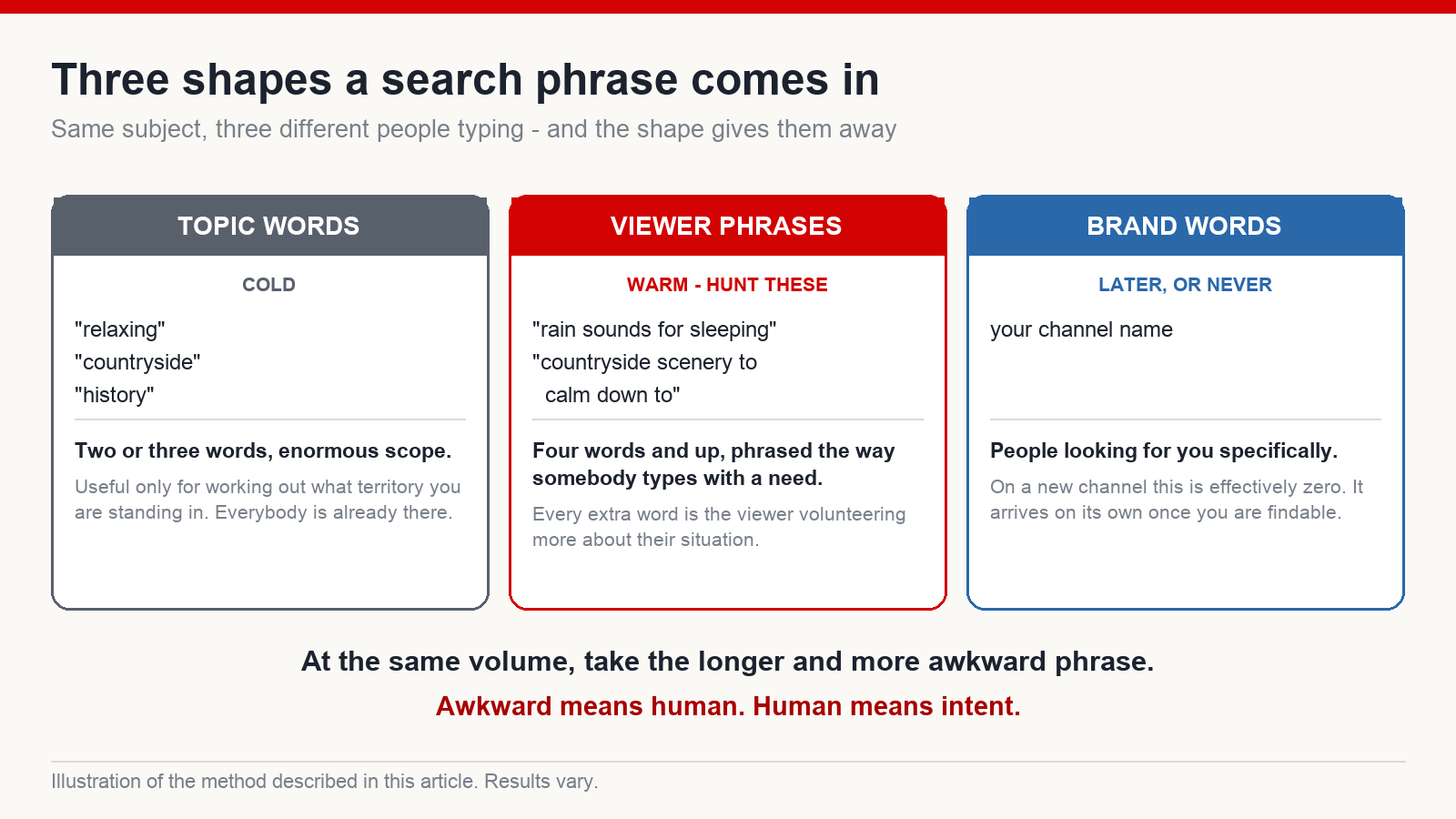
Topic words. Two or three words, enormous scope: “relaxing”, “countryside”, “history”. Useful only for working out roughly what territory you are standing in. Everybody is there. Do not build a video on one.
Viewer phrases. Four words and up, phrased the way somebody actually types when they have a need: “rain sounds for sleeping”, “countryside scenery to calm down to”, “how to keep chickens in a small back garden”. Every extra word is the viewer volunteering more about their situation. This is the shape I hunt.
Brand words. Your channel name. People typing it are looking for you specifically. On a new channel this is effectively zero, and there is nothing to do about it except become findable. It arrives later, on its own, or not at all.
So when two phrases sit at similar volume, take the longer, more awkward, more specific one. Awkward means human. Human means intent.
The part that reframes everything: search is the seed, not the harvest
Now the thing that stopped me cold the first time I understood it properly.
Videos that go big do not live on search. On my own channels, search delivers a very small slice of total views – low single-digit percentages, and I mean low. Nearly everything arrives through suggested videos and through the home feed. If you have never checked, open your own traffic-source report before you believe me or dismiss me; your split will be your own.
The reasonable reaction is: then why did I just spend five minutes choosing a phrase?
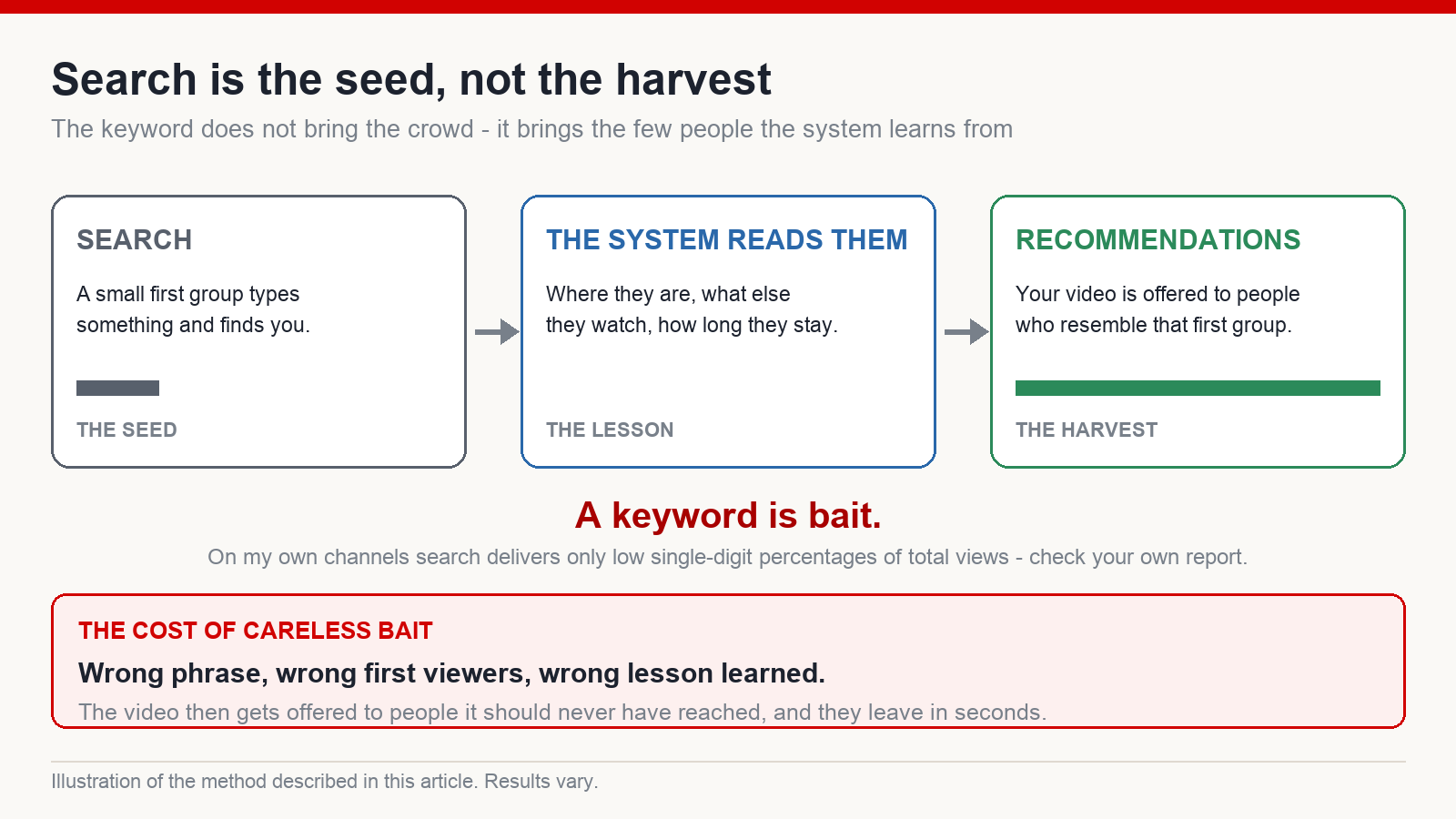
Because of who arrives first. The earliest handful of viewers on a new video overwhelmingly come from search – they typed something, they saw you, they clicked. And that group is the sample the platform studies. Where are they, how old are they, what else do they watch, how far into your video did they stay. Once it has read that sample, it starts offering your video to people who resemble them.
The keyword is bait. You do not catch the shoal with the bait; you catch the first few fish, and the first few fish tell the system where the shoal is.
Which is exactly why a careless phrase is expensive rather than harmless. Wrong bait pulls in the wrong first viewers. The system reads them faithfully and starts recommending your video to people it should never have been shown to. Those people leave in seconds. The video looks like a failure, and the failure traces back to a decision you made in a search box before you shot anything.
A worked example, and the trap sitting next to it
Let me run the check on something unglamorous, because unglamorous is where the room is.
Say the phrase is “learn cattle farming for beginners”. Nobody’s dream channel. Which is precisely the point – no large channel is bothering to make a patient beginner’s guide to keeping cattle, so the lane is still open, and open lanes are where a new channel can actually be seen.
Type it lowercase. Read the one field. Is it inside the band? Keep it if yes, drop it if no, and do not agonise – there are more phrases. Then check the shape: it is long, it names a skill level, it is unmistakably a viewer phrase. Good. That is the check finished, and I still have not opened an editor.
Then scroll to the suggested tags, and mind the trap.
Tag suggestions hallucinate. You are researching cattle and the tool starts offering you “sleep music” and “relaxing sounds” because they are large and vaguely adjacent in somebody’s data. The volume looks wonderful. People take them. Do not. Tags that contradict your subject give the system two incompatible stories about what your video is, and when it cannot resolve them it does the safe thing, which is to show your video to almost nobody.
Keep only the tags with actual blood relation to the subject: cattle care, livestock health, starting a smallholding, cattle breeding. Fewer and honest beats many and confused.
The five-minute check, written down
- Type the phrase into YouTube in lowercase, and read the autocomplete suggestions underneath it.
- Read one field only: estimated monthly search volume. Ignore every other score on the panel.
- Keep it if it lands inside your band; drop it without arguing if it does not.
- Check its shape – prefer the long, specific viewer phrase over the broad topic word.
- Use the surviving phrase as the seed: it goes in the title, the description and the tags so the system knows who to test the video on first.
There is no sixth step being withheld from you. The reason this works is not sophistication, it is that it fits inside the five minutes you actually have before your motivation runs out.
What this does and does not do
Let me be straight before you close the tab, because I would rather lose your click than sell you something.
This is a filter for wasted effort. It stops you spending a week on a phrase that had no chance, and it points the algorithm at roughly the right people on day one. That is all it is. It is not a mechanism for producing views, it does not shorten the number of videos you will have to make, and it is not financial advice of any kind. This work is unpredictable; income from it, if it comes at all, is uneven. Plenty of people learn every step of this and never publish anything.
What I can tell you is that the people who keep going are not the ones with the best instincts. They are the ones who stopped deciding by feel and started deciding by a rule small enough to obey on a bad evening.
If you want a structured English-language programme built around this way of working, that is what I run at mmoyoutube.com. And if you would rather just start: pick one phrase tonight, run the five steps, and let the result decide whether you script it.
Should the keyword go into the title word for word?
Close to it, but never at the cost of the title reading like a human wrote it. If the exact phrase fits naturally, use it. If it makes the title clunky, keep the important words and let the grammar breathe – the system reads your description, your tags and the video itself as well, so the title does not have to carry the whole load alone.
What if my phrase sits below the floor of the band?
I usually pass. Below the floor, even ranking first leaves you with an audience too small to teach the platform anything about your channel. The exception is a deliberate strategy of stacking many tiny, closely related phrases so they add up – that can work, but it needs volume of output, not one hopeful video.
If search delivers so few views, can I skip this entirely?
You can, and you will be handing the platform a video it cannot classify. The first viewers almost always arrive through search, and they are the sample everything downstream is built on. Skipping the keyword is not saving time; it is removing the bait and hoping the fish find you anyway.
How long until a new channel starts working with this approach?
I do not have a number for you and I would not trust anyone who offers one. It depends on the niche, the language market, how often you publish and how long you last. What choosing well does is stop you burning weeks in the wrong place. It does not shorten the road.
Do I have to pay for a keyword tool?
Not to start. Free tiers generally let you check one phrase at a time, which is exactly the pace of this check anyway. Paid tiers mainly buy you bulk lookups and larger related-phrase lists, which matter when you are planning twenty videos at once – not when you are trying to get the first one finished.